Dharavi Rehab Gains Momentum, 61 Hutment Owners Agree to Relocate
"Major breakthrough in Dharavi's Sector 6 redevelopment as 61 out of 85 hutment owners agree to vacate their homes, paving the way for rehabilitation construction. The remaining 24 families have until September 10 to finalize their move. This milestone marks a significant step towards clearing land for new construction, following
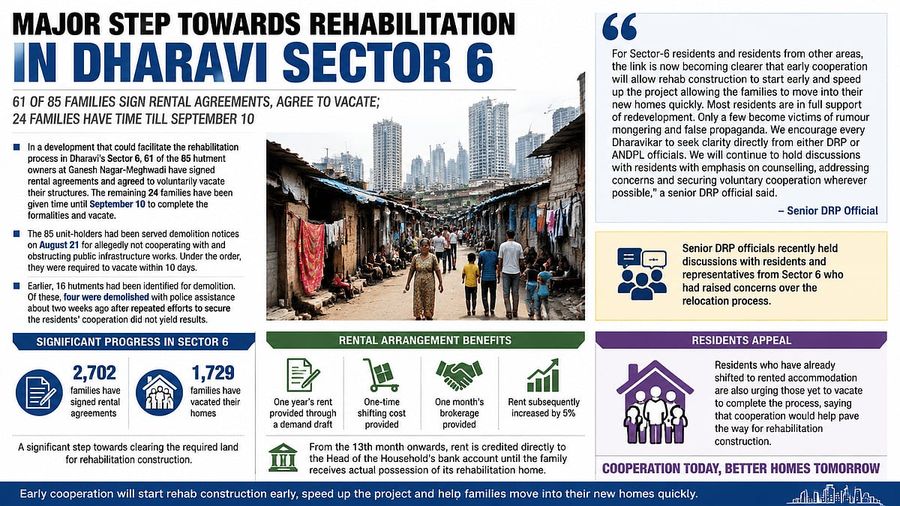
It was a sweltering summer morning in Mumbai's Dharavi, one of Asia's largest slums, when the news began to spread like wildfire. The air was heavy with anticipation as residents of Sector 6 huddled around dusty, hand-drawn maps etched on crumbling walls, their eyes scanning for any sign of the latest development. For months, the city's authorities had been engaged in a high-stakes game of cat and mouse with the recalcitrant hutment owners, who had refused to budge from their ancestral lands despite repeated entreaties. But on this fateful day, a breakthrough had finally materialized - 61 out of the 85 hutment owners had agreed to relocate, clearing the way for the long-awaited rehabilitation construction.
The sector, notorious for its narrow, winding alleys and cramped, ramshackle huts, had been the focal point of the city's ambitious redevelopment plan. With over 400,000 residents packed into an area roughly the size of a football field, the stakes were high - not just for the residents, but for the city's reputation as a beacon of progress and modernity. The authorities had been working tirelessly to persuade the holdouts to vacate their homes, but the task had proven more daunting than expected. The hutment owners, many of whom were elderly or had strong emotional ties to their land, had dug in their heels, unwilling to sacrifice their ancestral homes.
As the news of the breakthrough spread, a mix of emotions swirled through the community. Some residents, long weary of the squalid conditions and lack of basic amenities, saw the relocation as a long-overdue opportunity for a better life. They envisioned new, spacious homes, improved sanitation, and access to quality healthcare and education. Others, however, were more skeptical, fearing that the authorities would renege on their promises and leave them high and dry. There were also concerns about the impact on small-scale industries and livelihoods, which had long been the lifeblood of the sector.
At the heart of the controversy were the hutment owners themselves, a diverse group of individuals who had inherited their homes from their ancestors. Some were shopkeepers, others artisans, and a few were even small-time industrialists. While many were willing to relocate, others had grown attached to their homes, which had been passed down through generations. They saw the authorities' offer as a lowball deal, one that would leave them penniless and without a safety net. As the deadline for relocation loomed, the tension was palpable, with some owners still refusing to budge.
The authorities, led by the Municipal Corporation of Greater Mumbai (MCGM), had been working tirelessly to persuade the holdouts to vacate their homes. They had offered a range of incentives, including cash compensation, new housing, and even employment opportunities. But the hutment owners were not easily swayed, and the negotiations had turned into a high-stakes game of brinksmanship. As the days ticked by, the authorities grew increasingly desperate, aware that time was running out. The city's reputation was on the line, and the sector's redevelopment was crucial to its growth and development.
The breakthrough, finally, had come after months of intense negotiations. The MCGM had managed to secure the agreement of 61 hutment owners, who would receive a one-time compensation of Rs 10 lakh (approximately $13,000) each. The remaining 24 families had until September 10 to finalize their move, after which the authorities would take drastic measures to evict them. The news was met with a mix of emotions - relief, anxiety, and even hope. For some, it marked the beginning of a new chapter in their lives, while for others, it was a bitter pill to swallow.
Also Read

प्राथमिकता ज्वेल्स आईपीओ दिन 2 पर 21.23 गुना सब्सक्राइब, जानें नवीनतम जीएमपी और अन्य महत्वपूर्ण
निवेशकों के लिए बड़ा अवसर: स्टॉक एक्सचेंज में नौ दिनों के लिए खुलेगा बाजार। आईपीओ की सब्सक्रिप्शन 28 अगस्त से 1 सितंबर तक खुली हुई है। इससे पहले 27.5 करोड़ रुपये से अधिक की राशि को एंकर निवेशकों ने सुरक्षित कर लिया है।
As the sector teetered on the brink of change, the residents were left to ponder the implications of the breakthrough. Would the authorities keep their promises, or would they renege on their commitments? Would the new construction bring in the promised benefits, or would it lead to displacement and dislocation? The answers, for now, remained shrouded in uncertainty, leaving the residents to hold their breath as they waited for the next chapter in the sector's tumultuous history.
---
The breakthrough in Sector 6 marked a significant turning point in Dharavi's redevelopment saga. As the city's authorities looked to capitalize on the momentum, experts began to weigh in on the implications of the move. Dr. Rohan Deshpande, a leading urban planner, saw the relocation as a crucial step towards modernizing the sector. "Dharavi is a ticking time bomb, waiting to explode with the next outbreak of disease or fire," he warned. "By clearing the land, we can create a more sustainable, equitable, and livable environment for the residents."
Others, however, were more cautious in their assessment. Dr. Leela Parulekar, a leading sociologist, pointed out the human costs of the relocation. "The hutment owners are not just statistics or numbers - they are human beings with deep emotional ties to their land," she said. "The authorities must ensure that the compensation package is fair and adequate, and that the new construction is designed with the needs of the residents in mind." Dr. Parulekar also highlighted the potential impact on small-scale industries and livelihoods, which had long been the lifeblood of the sector. "The authorities must take a more nuanced approach, one that balances the need for modernization with the need to preserve the sector's unique cultural identity."
As the city's authorities looked to press ahead with the redevelopment plan, they faced a range of challenges. The sector's narrow alleys and cramped huts made it a difficult place to navigate, let alone build new infrastructure. Moreover, the authorities would need to contend with the complex web of interests and stakeholders that had long shaped the sector's development. Small-scale industrialists, shopkeepers, and artisans would need to be consulted and compensated, while the authorities would also need to ensure that the new construction was designed with the needs of the residents in mind.
The breakthrough in Sector 6 had also raised questions about the role of the state in the redevelopment process. Should the authorities be more proactive in engaging with the residents, or should they adopt a more hands-off approach? Dr. Deshpande argued that the state had a critical role to play in the redevelopment process. "The authorities must be the catalyst for change, using their resources and expertise to drive the redevelopment forward," he said. Others, however, were more skeptical, arguing that the state's role should be limited to providing support and resources, rather than driving the redevelopment process itself.
As the city's authorities looked to press ahead with the redevelopment plan, they would need to navigate a complex web of interests and stakeholders. The breakthrough in Sector 6 marked a significant turning point in the process, but it was only the beginning. The road ahead would be fraught with challenges, but it also offered opportunities for growth, development, and renewal. As the residents of Dharavi looked to the future, they held their breath, waiting to see what the next chapter in the sector's tumultuous history would bring.